AI in the SOC: Separating Promise from Practical Reality
Everywhere you look, vendors are promising “AI-powered detection,” “autonomous response,” and “next-generation SOC automation.” But beneath the marketing noise, cybersecurity professionals are left asking a more practical question:
What works in a modern SOC, and what’s still hype?
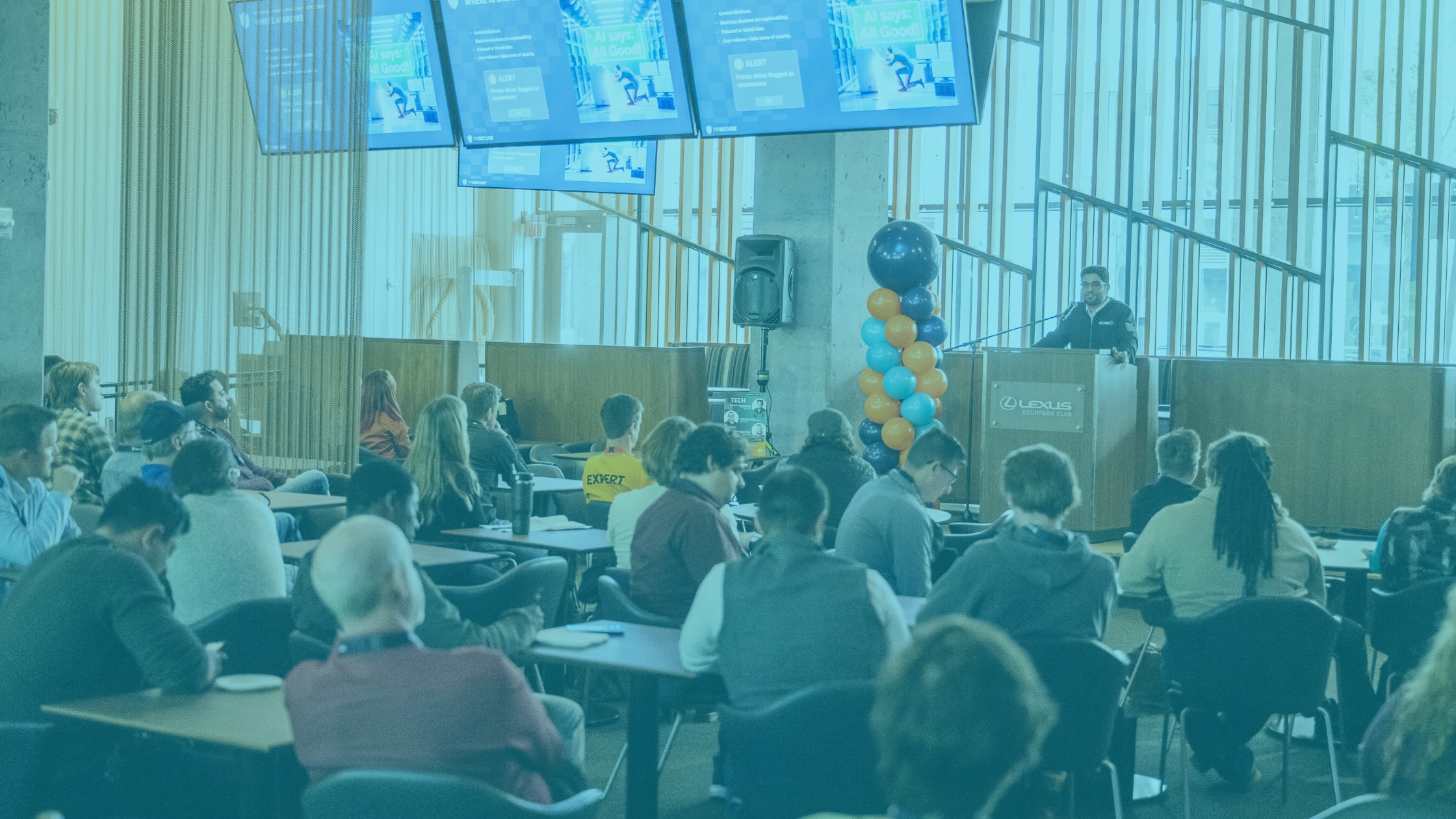
During my recent talks at Hacks & Hops in both Minneapolis and Missoula, I dug into this exact question. The goal was simple: offer a grounded, realistic, practitioner-level perspective on how AI is changing security operations today, what teams need to be cautious about, and where AI truly adds measurable value.
Below are the key insights from that discussion, stripped of buzzwords and aligned with the real-world challenges that SOC teams navigate every day.
AI isn’t replacing analysts. It’s amplifying them.
The narrative that AI will eliminate SOC roles is fundamentally disconnected from how AI works in operational environments.
AI today excels at:
- Pattern recognition
- Data classification
- Predictive scoring
- Summarization
- Rapid correlation
But it cannot:
- Make contextual business-level decisions
- Understand intent
- Validate legitimacy outside observed patterns
- Replace human intuition and judgment
- Shoulder full accountability for security outcomes
The reality is this: AI makes good analysts great, and overwhelmed analysts functional.
Instead of removing humans from the loop, the most successful SOCs are using AI to augment human teams, enabling analysts to spend more time on critical thinking and less on repetitive work.
Alert fatigue is a data problem. AI can help, but only if configured well.
Most SOCs drown in tens of thousands of alerts per day. AI can dramatically improve signal-to-noise ratio, but it isn’t magic.
For AI-based alert reduction to work, you need:
- High-quality, well-structured telemetry
- Clear baselines of “normal” activity
- Good labeling of historical detection outcomes
- A feedback loop from human analysts
- Continuous tuning
Without those, AI simply learns from the same noisy patterns that are producing the overload in the first place.
At its best, AI helps analysts focus on the 1–2% of alerts that matter, while suppressing background noise responsibly and transparently.
SOC automation must be human-led, not machine-driven.
Security automation is only as strong as the strategy guiding it. Even the most mature AI-driven SOCs keep humans in the decision chain, especially for high-impact actions like containment, blocking, or remediation.
The safest and most effective SOCs use AI to:
- Recommend actions
- Enrich context
- Score urgency
- Highlight anomalies
- Draft response steps
But they rely on humans to validate and execute key steps in the kill chain, ensuring accountability and preventing cascading failures caused by false positives.
This hybrid model (human-led, AI-powered) continues to outperform both traditional manual SOCs and overly automated ones.
Deepfakes, impersonation, and AI-enabled social engineering are growing faster than defenses
Unfortunately, AI isn’t only benefiting defenders. Attackers are using it too.
Deepfake impersonation, real-time voice synthesis, AI-powered phishing, and automated recon tools are now cheap, accessible, and disturbingly convincing.
For SOC teams, this means:
- Identity verification protocols must evolve
- Phone-based approval workflows are increasingly risky
- MFA fatigue attacks are becoming more creative
- Social engineering patterns are harder to detect with traditional tools
Human judgment continues to be one of the most effective defenses, especially when paired with AI-based anomaly detection that can flag subtle behavioral deviations attackers can’t easily mimic.
Telemetry quality will determine who thrives in the next wave of AI security.
AI models are hungry. They need clean, complete, and contextualized data to work effectively.
The SOCs seeing the biggest AI gains have invested heavily in:
- Unified logging
- High-fidelity endpoint telemetry
- Normalized event schemas
- Enriched identity data
- Clear mappings between alerts, assets, and business systems
The better your telemetry, the more powerful (and reliable) your AI becomes.
Poor telemetry? Your AI will hallucinate, miss threats, or worse, trust the wrong signals. And that’s a risk no SOC can afford.
The SOC of the future will be more human, not less.
AI will handle:
- Noise reduction
- Log correlation
- Pattern detection
- Initial response drafting
Humans will handle:
- Strategic response decisions
- Threat modeling
- Creative problem solving
- Cross-functional communication
- Understanding business impact
- Accountability and ethics
The cybersecurity field doesn’t need more hype. It needs clarity, practical frameworks, and a realistic understanding of both the power and limits of AI in the SOC.
As shared at Hacks & Hops in Minneapolis and Missoula, the goal isn’t to chase the newest buzzword. It is to build SOC teams that are more resilient, more efficient, and more human-centered than ever.
If AI helps us get there (and it can) it’s because practitioners lead the way, designing thoughtful, responsible, and strategically aligned implementations.
As your team is considering how to modernize SOC operations with AI, I’m always open to sharing frameworks, lessons learned, and real-world examples. Get in touch.